Executive Summary
Ankle injuries are frequent in Singapore due to active outdoor lifestyles, urban commuting, and sports activities. Identifying whether ankle pain stems from a ligament sprain, a bone fracture, or chronic joint degradation is essential for effective treatment. Immediate medical evaluation by an orthopaedic doctor helps prevent long-term instability and cartilage damage. This guide outlines symptoms, diagnostic pathways, second opinion benefits, and modern management strategies available in local clinics.

Dr David Su Hsien Ching
Senior Consultant Orthopaedic Surgeon
With over 15 years of experience in public service, Dr David Su treats a wide spectrum of complex foot and ankle conditions at Asian Healthcare Specialists.
Introduction
A sudden misstep off a kerb in Raffles Place or an awkward landing during a weekend run at East Coast Park can trigger sharp ankle pain Singapore residents often try to walk off. While many assume a twisted ankle is merely a mild strain that will heal with rest, underlying structural damage can be significantly more complex. Distinguishing between a soft tissue ligament sprain and a bone fracture is not always straightforward based on immediate pain levels alone.
Delaying accurate evaluation can turn an acute, manageable injury into a lingering issue. Chronic instability, persistent swelling, and early joint wear often develop when torn ligaments or hairline fractures go unnoticed. Seeking prompt medical assessment ensures that joint structures are evaluated correctly from the outset. Whether managing a fresh trauma or coping with persistent discomfort from an old injury, understanding the clinical pathways available in Singapore empowers you to take control of your mobility.
Understanding Ankle Pain Singapore: Primary Causes and Joint Vulnerabilities
The ankle joint bears your full body weight with every step while accommodating multi-directional movement over uneven pavements and wet footpaths. It relies on a delicate balance of bones, ligaments, and tendons working in harmony. Ankle pain commonly arises from acute trauma, structural instability, or overuse. Proper identification of the affected structure ensures appropriate recovery protocols and safeguards future joint health.
Primary factors contributing to localised ankle distress include:
- Inversion injuries where the foot rolls inward, stretching or tearing lateral ligaments.
- Direct impact or sudden twisting forces that create fractures in the tibia, fibula, or talus.
- Overuse tendinitis resulting from repetitive stress during running or racquet sports without adequate rest.
- Post-traumatic arthritis caused by previous unaddressed injuries leading to cartilage wearing over time.
Ankle Sprain vs Ankle Fracture: Key Differences and Diagnostic Symptoms
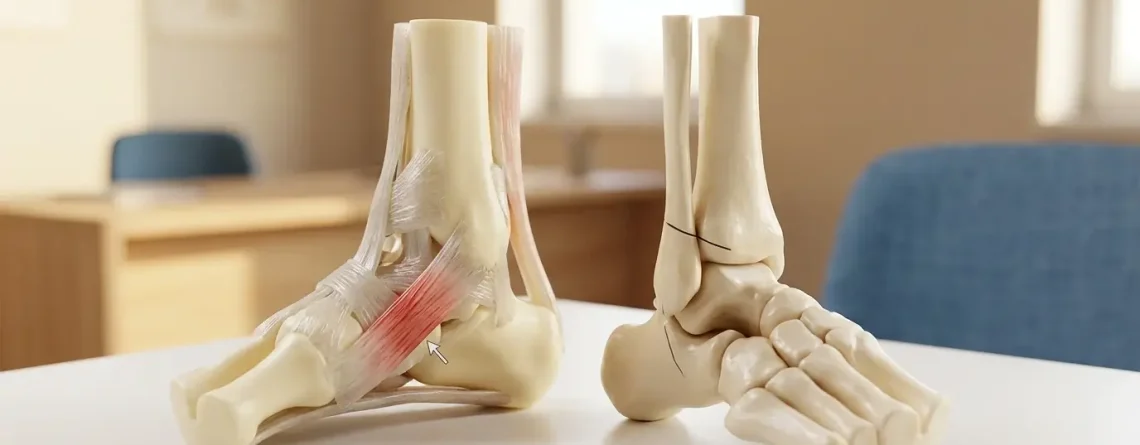
Differentiating between a sprained ligament and a broken bone can be challenging because both conditions present with pain, swelling, and localised bruising. However, key clinical indicators differentiate these two conditions. Sprains involve stretched or torn ligaments, whereas fractures involve broken bones. Inability to bear weight immediately after an injury often signals a potential fracture requiring urgent evaluation.
When a sprain occurs, the bands of tissue connecting your bones stretch beyond their normal limits. Mild sprains allow for partial weight-bearing with discomfort, while severe sprains involve complete ligament tears that feel unstable. In contrast, an ankle fracture involves a crack or complete break in one or more bones comprising the joint.
Symptoms suggesting a potential fracture rather than a simple sprain include:
- Immediate, severe swelling accompanied by visible deformity or unnatural bone alignment.
- Inability to place any weight on the affected foot for four steps immediately after the incident.
- Pinpoint tenderness when pressing directly on the bony prominences of the outer or inner ankle.
- Numbness, tingling, or coldness in the toes, indicating nerve or vascular compression.
Diagnostic Pathways: When Should an Orthopaedic Doctor Take a Look?
Self-diagnosis and simple home remedies like ice and elevation are often insufficient for moderate to severe injuries. Knowing when to transition from basic home care to specialist consultation prevents long-term joint compromise. Medical evaluation is recommended if pain prevents walking, swelling persists past 72 hours, or mechanical symptoms like clicking, locking, or giving way occur.
An orthopaedic doctor evaluates structural integrity through physical examinations and targeted diagnostic imaging. Plain X-rays reveal bone fractures and joint alignment, while Magnetic Resonance Imaging (MRI) scans provide detailed views of soft tissues, including ligament tears, tendon damage, and articular cartilage lesions.
Early orthopaedic evaluation is critical if you experience persistent swelling that does not subside after a few days of rest, recurrent ankle giving way during routine daily walking, or mechanical locking inside the joint space. Addressing structural deficits early prevents adaptive gait changes that can subsequently affect your knees, hips, and lower back.
Clinical Pathway Comparison for Ankle Assessment and Care
Selecting the appropriate evaluation pathway depends on injury severity, symptom duration, and functional limitations.
Persistent Discomfort: Seeking a Second Opinion for Chronic Ankle Pain
Living with ongoing ankle discomfort after an initial injury has allegedly healed is a common concern among active adults in Singapore. When rest, basic therapy, and time fail to yield full functional recovery, seeking a second opinion from an experienced orthopaedic specialist provides fresh diagnostic clarity. Second opinions re-evaluate initial diagnoses, utilising advanced imaging to identify subtle cartilage defects, hidden ligament laxity, or joint impingement missed during initial acute care.
Chronic ankle instability frequently develops after repeated micro-sprains or incomplete healing of a major ligament tear. Over time, loose ligaments permit subtle joint sliding, eroding the protective cartilage and accelerating joint wear. A senior consultant brings extensive experience in identifying subtle structural irregularities, scar tissue impingement, or occult talar dome lesions.
During a second-opinion consultation, the specialist conducts a thorough review of your medical history, prior imaging, and functional movement patterns. Re-assessing your ankle with updated dynamic imaging helps formulate a refined management plan tailored to your specific lifestyle goals and physical demands.
Non-Surgical and Surgical Treatment Options in Singapore
Orthopaedic care emphasises conservative management whenever clinically appropriate, reserving surgical intervention for severe structural disruption or cases where conservative measures have failed to restore stability.
Non-surgical strategies include structured physical therapy programmes aimed at restoring joint proprioception, peroneal muscle strength, and flexibility. Custom orthotic shoe inserts can correct biomechanical alignment, reducing unnecessary stress on vulnerable ligament complexes. Targeted anti-inflammatory strategies and temporary offloading boots facilitate tissue recovery during acute flare-ups.
When surgical treatment is indicated, modern techniques prioritise tissue preservation and efficient recovery. Keyhole arthroscopic procedures allow orthopaedic surgeons to clear inflamed joint lining, remove loose fragments, or repair damaged cartilage through minute incisions. For severe instability or complex fractures, minimally invasive ligament reconstruction or precise anatomical fracture fixation restores structural alignment, allowing patients to resume active daily routines safely.
Rehabilitation and Returning to Active Lifestyle in Singapore
Recovery does not end when initial pain subsides. A tailored rehabilitation programme is essential to rebuild strength, flexibility, and spatial awareness before returning to sports or intensive physical activities.
Progressive rehabilitation focuses on balance training using unstable surfaces, strengthening the stabilising muscles around the lower leg, and practising sport-specific agility drills. Adhering to structured recovery timelines minimises the risk of re-injury, ensuring long-term joint endurance whether navigating city streets or participating in competitive sports.
Conclusion: Taking Proactive Steps for Long-Term Ankle Mobility
Ankle pain should never be dismissed as a temporary inconvenience. Whether dealing with an acute twist or persistent aching from an old injury, obtaining an accurate diagnosis from an orthopaedic specialist protects your long-term mobility and quality of life. Timely clinical intervention helps differentiate simple sprains from complex fractures, ensuring appropriate treatment protocols from day one.
Protect Your Long-Term Mobility
Don’t let ankle pain or instability limit your active lifestyle. Schedule an accurate assessment with our specialist team to secure your path to recovery.
Frequently Asked Questions
How can I tell if my ankle is sprained or broken?
It is difficult to distinguish a sprain from a fracture without professional medical imaging. Generally, a fracture presents with severe, immediate pain, rapid swelling, visible deformity, and an inability to bear any weight on the foot. Sprains also cause pain and swelling, but weight-bearing may still be partially possible depending on severity. If you cannot walk four steps, seek immediate orthopaedic evaluation.
How long does an ankle sprain take to fully recover?
Recovery timelines depend on the severity of the ligament damage. Mild Grade 1 sprains typically resolve within two to four weeks with proper care. Moderate Grade 2 sprains require six to eight weeks of structured rehabilitation. Severe Grade 3 sprains involving complete ligament tears may take several months to heal fully and often require specialised physiotherapy or surgical consultation to regain stability.
When should I seek a second opinion for chronic ankle pain?
You should consider a second opinion if your ankle pain, swelling, or instability lasts longer than three months despite completing initial treatment or physical therapy. A senior orthopaedic consultant can re-evaluate your condition with detailed diagnostic imaging to check for chronic ligament laxity, cartilage damage, or joint impingement that may have been initially overlooked.
Can chronic ankle instability lead to early joint arthritis?
Yes, persistent instability allows abnormal movement within the ankle joint, causing uneven wear and tear on the protective articular cartilage over time. This continuous friction can accelerate joint degeneration, leading to post-traumatic ankle arthritis. Prompt specialist intervention to restore joint stability significantly reduces the risk of long-term cartilage degradation.
What non-surgical treatments are available for ankle pain in Singapore?
Non-surgical options include structured physiotherapy for balance and muscle strengthening, custom biomechanical orthotics, temporary immobilization bracing, and targeted pharmacological anti-inflammatory support. Many patients achieve excellent functional recovery through dedicated conservative care programmes designed by orthopaedic specialists without requiring surgical intervention.